Genuine Leather Keychain vs PU Leather Keychains: Cost, Durability, and Best Uses
Table of Contents Leather keychains are a massively popular category in the world of custom corporate gifts. They are highly
When graphic designers and artists set out to create highly intricate merchandise, the most critical decision revolves around the manufacturing process.
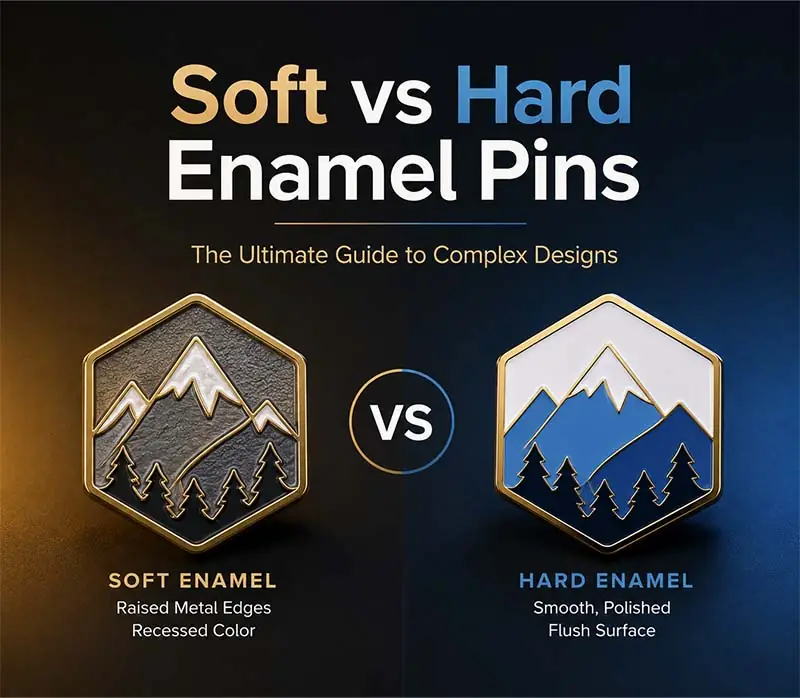
The soft vs hard enamel pins debate is especially prominent when dealing with highly complex art. Choosing the right format for your pin order dictates how well fine detail translates from a digital proof to physical metal.
This guide breaks down the nuances of hard and soft enamel to help you determine which process is best for your complex idea.
Before exploring the differences in paint application, it is important to understand that both styles start the exact same way.
The foundational production process begins by casting your intricate pin design into a raw metal base, creating die cast pins.
This casting action forms deep recessed areas and thin, raised metal edges.
These metal edges serve as the retaining walls for the enamel filling.
Whether you are making basic custom pins or a highly complex lapel pin, a well-crafted die cast base is the foundation of structural quality.
Without the liquid pigment, you simply have unpainted, textured metal pins. The way the factory applies paint to this base determines whether it becomes hard or soft enamel.
When finalizing your custom lapel accessories, you must evaluate how your chosen paint style interacts with the metal plating.
The right plating frames your complex design and ensures it remains legible.
Shiny Plating: Options like shiny gold or polished silver catch the light beautifully and offer a premium feel. However, highly reflective surfaces can sometimes cause glare, making ultra-complex custom lapel pins slightly harder to read from a distance.
Dark Contrast: Utilizing black metal or black nickel provides sharp, comic-book-style outlines that enhance readability. This is the best choice for separating bold color in a complex pin.
Matte Finishes: A matte plating reduces shine entirely, which is an excellent way to highlight the enamel itself without distracting reflections.
Once you have decided on the base style, you can elevate your own custom enamel pins with unique upgrades for a minor additional cost.
A complex design can be transformed into an interactive collectible with just a few modifications.
You might add transparent colors layered over a 3D textured metal background, drop in a rhinestone for elegance, or use a red dye and glow-in-the-dark paint to highlight specific features.
If you want mechanical interactivity, engineering a bearing spinner allows a top metal layer to rotate freely on a high-quality bearing. You can even incorporate a lenticular effect that shifts the printed graphics as you tilt the product.
For attachments, you can swap standard butterfly clutches for two rubber clutches or a strong magnet to protect delicate fabrics. Even when designing just one pin concept, incorporating these premium features yields a stunning result.
If your customized pins feature tiny text, tightly packed geometric lines, or complex character illustrations, soft enamel pins are almost always the superior choice.
In this method, the liquid enamel is injected into the recesses and cured in an oven. Because there is no mechanical polishing step afterward, the paint sits naturally below the metal, providing a highly tactile texture.
On the other hand, hard enamel pins are famous for their exquisite, flat, and flawlessly smooth surface. To achieve this high grade finish, the factory overfills the cavities with paint, bakes them at extreme heat, and grinds the entire surface down until the paint is perfectly flush with the metal. While this results in a stunning, jewelry-like piece, the intense grinding phase can slightly thicken or widen the metal lines.
If your artwork is overly complex, this grinding might obscure microscopic details. However, for bold, corporate logos where a polished look is mandatory, hard enamel is the ultimate premium choice.
Bringing your complex artwork to life requires navigating a few basic manufacturing logistics. Most factories require a minimum order quantity to offset the heavy initial cost of casting a unique steel mold.
Fortunately, once that mold is created, the unit price drops significantly, allowing you to secure a full range of merchandise with fast production and fast shipping.
Soft enamel pins are generally more affordable to produce than hard enamel pins. That lower cost makes them effective for large promotional orders and popular for promotional giveaways.
If you are planning to design your own enamel pins and are unsure how your complex art will translate to physical metal, rely on a manufacturer that offers free design support.
A professional design team can provide unlimited revisions and help you refine your design ideas.
They will advise you on whether your lines are thick enough to hold paint, ensuring your custom product is ready for flawless production.
The choice between soft and hard styles ultimately comes down to balancing line clarity with your desired surface finish.
Soft styles protect intricate details, while hard styles offer a sleek, premium feel.
By understanding these differences, you ensure your final product perfectly matches your creative vision.
Are you ready to make pins with the experts and create your own pins?
Contactus today to get a free quote from experienced pin makers and take advantage of our rapid turnaround time.

Table of Contents Leather keychains are a massively popular category in the world of custom corporate gifts. They are highly

Table of Contents Finding the right manufacturing style for branded merchandise can be challenging for corporate buyers. High quality pvc
No. 5, Tongan Road,
East District Xiaolan Town,
Zhongshan, Guangdong,
China