Company Logo Keychains Packaging Guide: OPP Bags, Backing Cards and Gift Boxes
Table of Contents Packaging is often the last thing corporate buyers consider when designing a custom keychain. However, it completely
A custom keychain is small, but the quality gap between what gets approved in a digital proof and what actually ships can do outsized damage to a brand.
A mismatched color, a warped body, a loose split ring, or an early sign of rust all reflect directly on the company handing it out.
The challenge for most B2B buyers is that you can’t personally inspect every unit coming off a production line, and if your factory is overseas, you often can’t inspect any of it in person before it’s produced, boxed, and already on a container. By the time a defect shows up in your own warehouse, a return or reorder costs far more than catching it before shipment would have.
This checklist walks through what to look for at each stage, so buyers and a factory’s QC team can work from the same standard before goods ever leave the production floor.
Start with what’s visible to the eye, the details your designers spent the most time getting right, and what a recipient notices first on any company logo keychains:
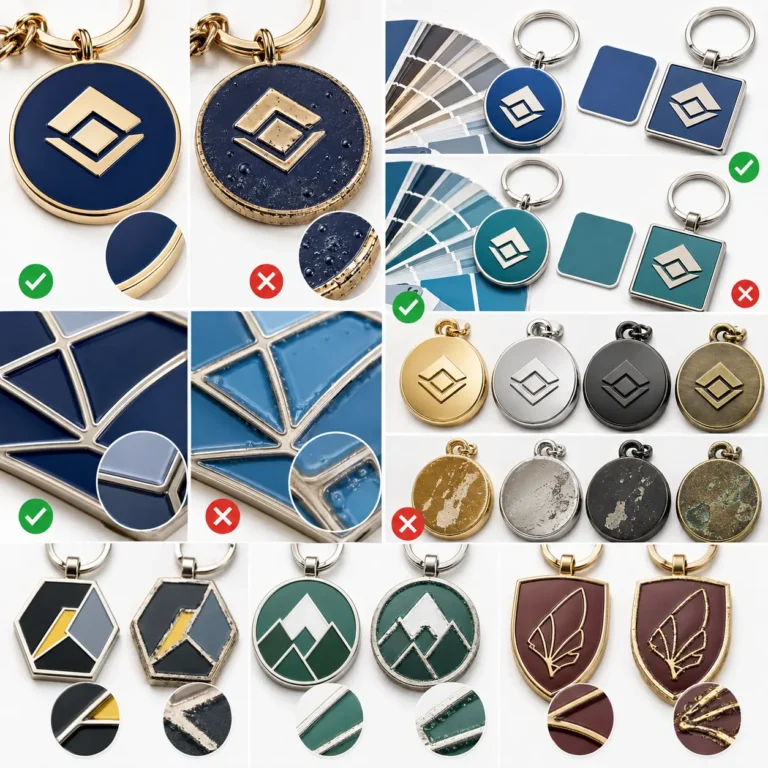
Surface free of scratches, bubbles, pinholes, or burrs
Color matches the approved Pantone code (cross-checked against the same color library entry used on the proof) and reference sample, with no visible deviation
Enamel fill is complete and level, with no sunken areas or color bleeding between cells
Plating is even across the piece, with no peeling, streaking, or early oxidation
Logo and text outlines are sharp and clean, with no blurred or crooked edges
Appearance can look fine while the underlying build is still off:
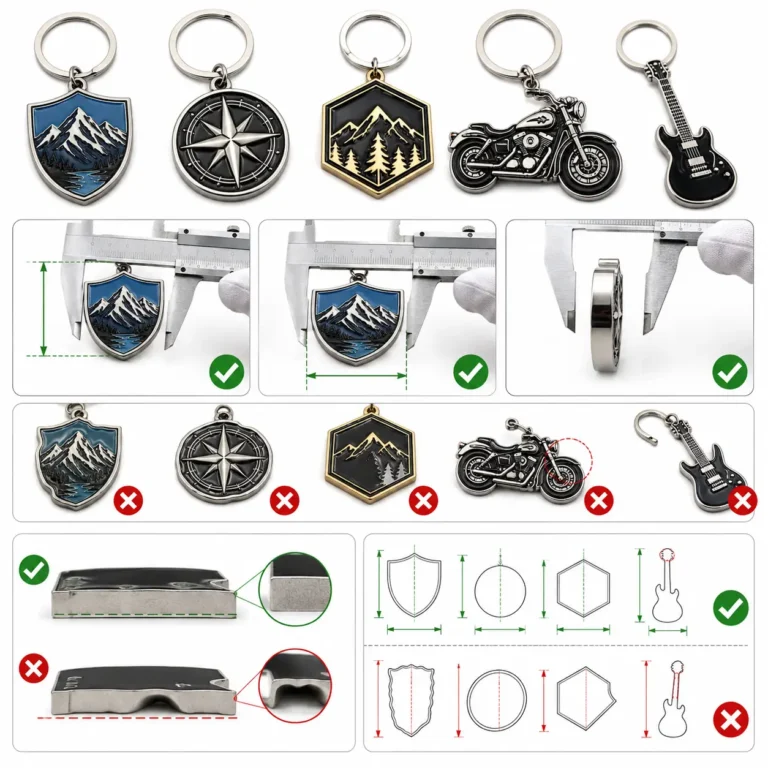
Overall shape and size, length, width, and thickness, fall within the agreed design tolerance
Thickness is consistent across the piece, with no thin spots that risk cracking or breaking
Cutout and bridge areas (the thin connectors around any negative space) are sturdy, not fragile
On double-sided enamel pieces, front and back designs align correctly, with no misregistration
Hardware failures are one of the most common reasons a shipment gets flagged during receiving inspection, even on well-made metal enamel keychains:
Hardware features, split rings, lobster clasps, carabiners, open and close smoothly
Attachment points are securely fastened, with no weak joints or risk of detachment
Hardware shows no rust, oxidation, or uneven plating
A basic load test, simulating a full set of keys pulling on the ring, confirms the attachment holds under everyday use
Material choices affect both durability and compliance, especially once a shipment crosses a border, and choosing durable materials like custom PVC promotional keychains improves the effectiveness of promotional keychains because the item stays in use longer:
Material matches the order specification, zinc alloy, stainless steel, or soft, flexible, lightweight polyvinyl chloride, whichever was confirmed on the proof; PVC keychains are made from durable polyvinyl chloride
Relevant safety certifications are met for the target market. For example, REACH in the EU or CPSIA for shipments headed to the USA, and if PVC was ordered, verify it is waterproof and tear-resistant
Edges and corners are safely finished, with no sharp burrs that risk cuts, and if PVC was selected, confirm colors are built into the material itself for consistent color throughout the piece
Any eco-friendly coatings or platings comply with hazardous substance limits for the destination country
Packaging is often the last checkpoint before a box leaves the factory, and it’s where customization options for presentation get verified on custom promotional keychains:
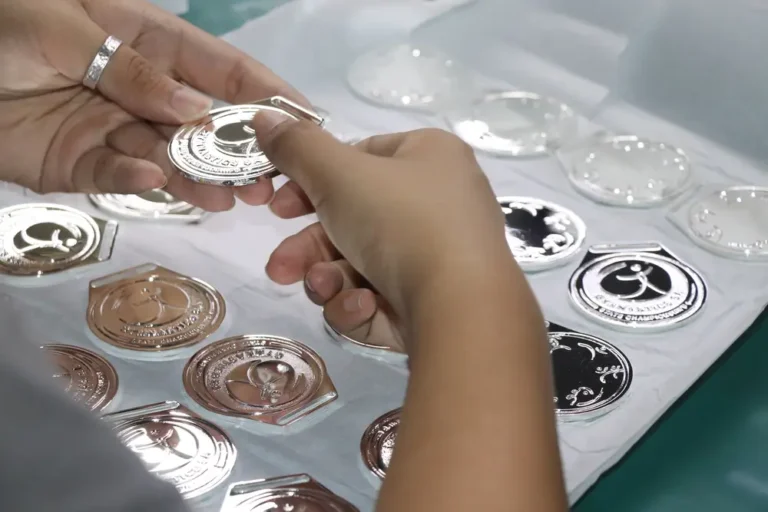
Individual packaging (poly bag, box, or blister pack) matches what was requested in the order
Quantity matches the order exactly, with no shortages or overages
Carton and label information is accurate. Brand name, barcode, and country of origin are all printed correctly
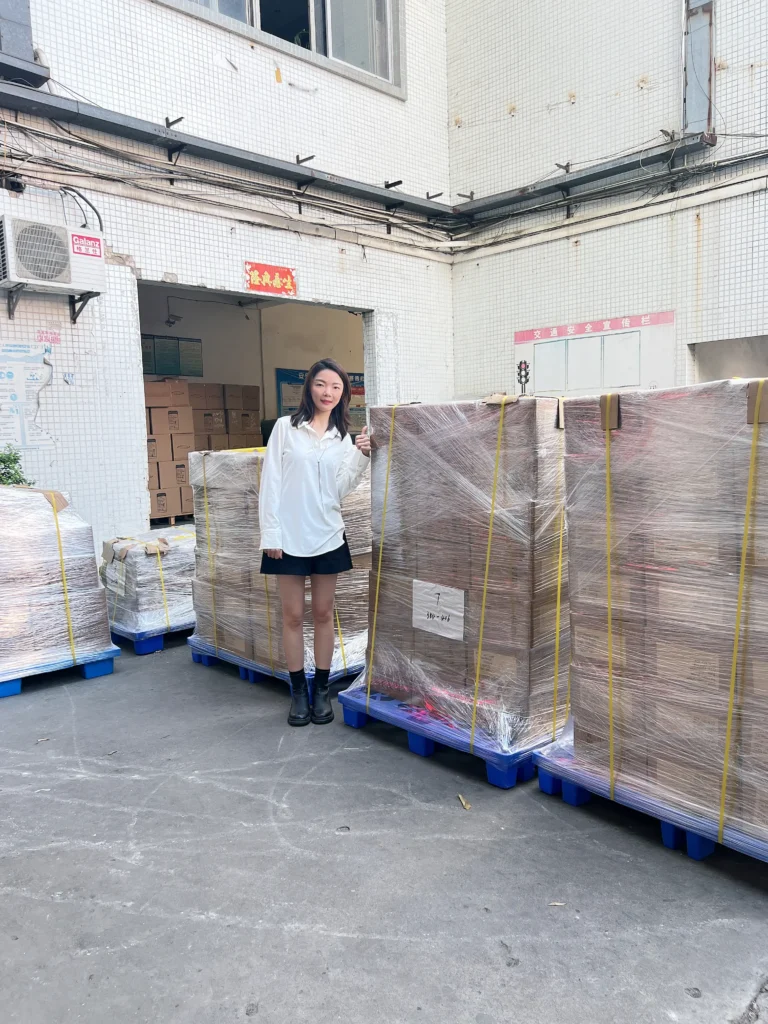
Outer shipping packaging is sturdy enough to prevent damage or deformation in transit
Most buyers don’t inspect every single unit in a bulk order.
Instead, a sample is pulled and checked against an agreed standard, most commonly an AQL (Acceptable Quality Limit) of 2.5 for general keychain products, though buyers with tighter tolerances sometimes choose a stricter level.
Within that standard, defects typically fall into three tiers:
Critical defects (a safety risk, such as a sharp edge or a choking-hazard-sized loose part), major defects (a functional or clearly visible flaw, like a broken clasp or an obvious color mismatch), and minor defects (small cosmetic issues unlikely to affect use, like a faint scuff).
A shipment passes or fails based on how many defects of each type turn up in the sample, not a single flawed piece.
A useful inspection report includes clear photos or images of any defect found, measurement or count data against each checklist item, a cross-check against the original design files, and a short written conclusion, often uploaded alongside the shipment paperwork, stating whether the batch passed, failed, or needs rework before it ships.
Because custom keychains are an affordable marketing option for high-volume giveaways, preventing common defects matters. They also act as portable advertising that travels with customers and is more likely to be retained when it is useful:
Color mismatch, usually traced back to inconsistent Pantone matching; solved by requiring a physical color reference alongside the digital proof, not just a screen comparison
Warping, often a sign of rushed cooling or curing; a mid-production inspection added early in the timeline can catch it before a full batch is affected
Rust or fade over time, usually a plating or coating issue; confirm the plating thickness and finish type before the run begins
Loose attachments, typically a fastening or crimping problem; a simple load test on the first units off the line catches it early
Setting QC expectations with the factory upfront, confirming a sample, agreeing on acceptable tolerances, and keeping a signed reference sample on file, does more to prevent these issues, and to streamline resolution when one does slip through, than any inspection after the fact.
The core idea behind every item on this list is simple: prevention is cheaper than rework. Catching a color mismatch, a weak clasp, or a batch of overly thin cutouts before a shipment leaves the factory costs a fraction of what it costs to catch it after your own customers already have the box in hand.
Print or save this checklist and keep it on hand for every incoming order. It works whether you’re reviewing photos from a factory’s own QC team or doing a walkthrough of a physical sample yourself.
PeaKeen builds this kind of pre-shipment inspection into every bulk order for its B2B clients, sharing photos and measurements against this same set of checkpoints before goods leave the factory. Defining your QC standard upfront, rather than after a shipment already arrives, is worth requesting in writing from any manufacturer you work with.
Branded company logo keychains work well for trade shows, customer gifts, and corporate events because they are lightweight and easy to distribute, and well-made custom keychains can last 4–5 years, extending brand visibility at events and beyond.

Table of Contents Packaging is often the last thing corporate buyers consider when designing a custom keychain. However, it completely

Table of Contents Fabric keychains are a popular choice for soft, lightweight custom merchandise. Woven and embroidered are the two
No. 5, Tongan Road,
East District Xiaolan Town,
Zhongshan, Guangdong,
China
10% Off