Company Logo Keychains Packaging Guide: OPP Bags, Backing Cards and Gift Boxes
Table of Contents Packaging is often the last thing corporate buyers consider when designing a custom keychain. However, it completely
Choosing keychain size isn’t just aesthetic. A ring that’s too small is hard to manipulate; one that’s too large bulges in a pocket.
For businesses ordering custom keychains in bulk, matching size and hardware to actual use cases keeps recipients using the piece instead of discarding it.
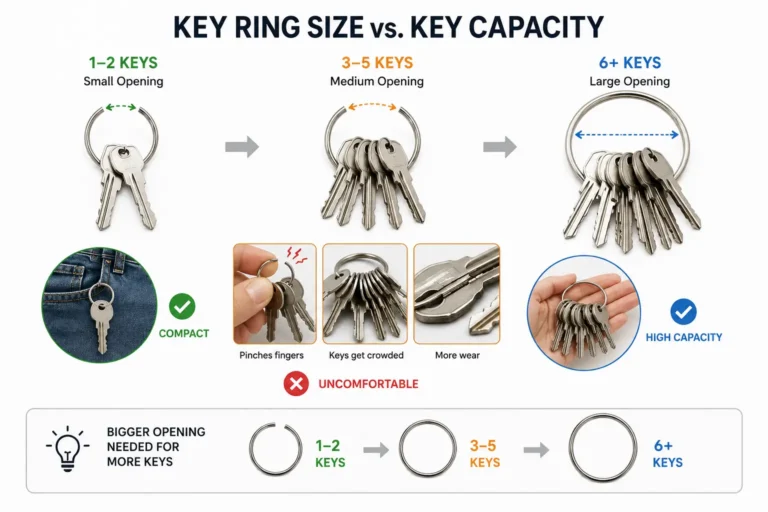
Keychain size determines usability more than most buyers realize. Ring diameter constrains key capacity, ease of opening, and pocket comfort.
A small ring (19–25mm) holds 1–2 keys comfortably and fits a pocket. Force five keys onto it, and fingers get pinched, keys bunch, and wear accelerates.
A large ring (32mm+) accommodates 6+ keys but becomes bulky for minimal users. The relationship is physical: more keys require wider opening, which requires larger diameter.
Beyond comfort, wrong size creates secondary problems. An undersized ring in a pocket scratches or deforms under stress. An oversized ring for a minimal keyset looks disproportionate and wastes material cost.
Ring size must align with the user scenarios you’re solving for, especially when you’re ordering custom company logo keychains meant for long-term daily use.
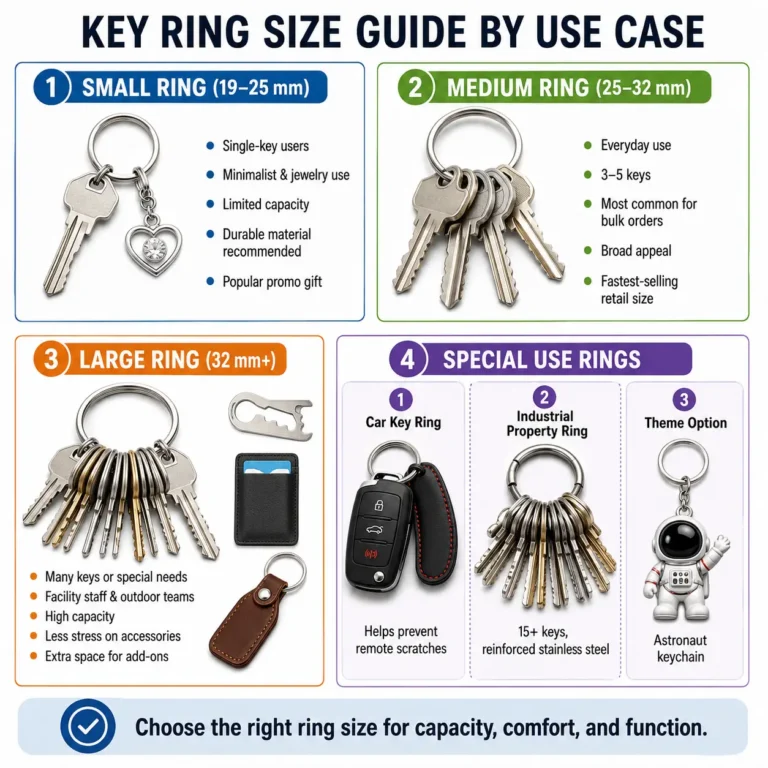
Keychain sizing falls into predictable categories, each addressing a specific use pattern. Understanding these categories helps a buyer land on the best size for their end-user base.
Small keychains (19–25mm): single-key users, minimalists, jewelry pieces. Limited capacity; must use durable material to customize properly. Popular as promotional keychains for those who purchase gifts.
Medium keychains (25–32mm): everyday use (3–5 keys). Most common for bulk orders, broadest appeal. Retail shops report they move fastest.
Large keychains (32mm+): many keys or specialized needs (facility managers, outdoor teams). Accommodates volume, reduces stress on attachments, and leaves room to produce integrated tools, access card holders, or genuine leather keychain accents.
Special-purpose rings: car key rings (prevents fob scratching), industrial property management rings (15+ keys, stainless-reinforced), and themed options like astronaut keychains.
The metal or acrylic selected for a keychain ring isn’t purely aesthetic — it directly affects how durable the piece is at a given size, how easily keys slip on and off, and how well the ring resists pinching and deformation.
Stainless steel is the durability standard, resisting corrosion and deformation. It can be thinner than other metals while staying rigid — a 1.5mm stainless ring won’t flatten when pinched, while the same thickness in brass or aluminum would crease. For small rings especially, stainless steel is essential because the smaller diameter stresses the material more during daily use.
Brass offers premium aesthetics and good corrosion resistance, but is softer and requires thicker walls (2–2.5mm) to stay rigid at small sizes, making it ideal for metal enamel logo keychains where weight and finish both matter. Brass develops a natural patina over time; clarify with your team whether that reads as character or tarnishing.
Aluminum is lightweight and affordable but the softest metal. Below 25mm, it dents easily and looks worn within months, so it’s often paired with separate custom enamel charms when you want color without excess bulk. Works best at medium-to-large sizes where diameter provides stiffness.
Material-size pairing rule:
Small keychains need stainless steel or thicker brass;
Medium keychains tolerate any material but quality perception varies;
Large keychains are more forgiving.
Choosing the right material upfront helps you save money on returns and maintain great quality perception.
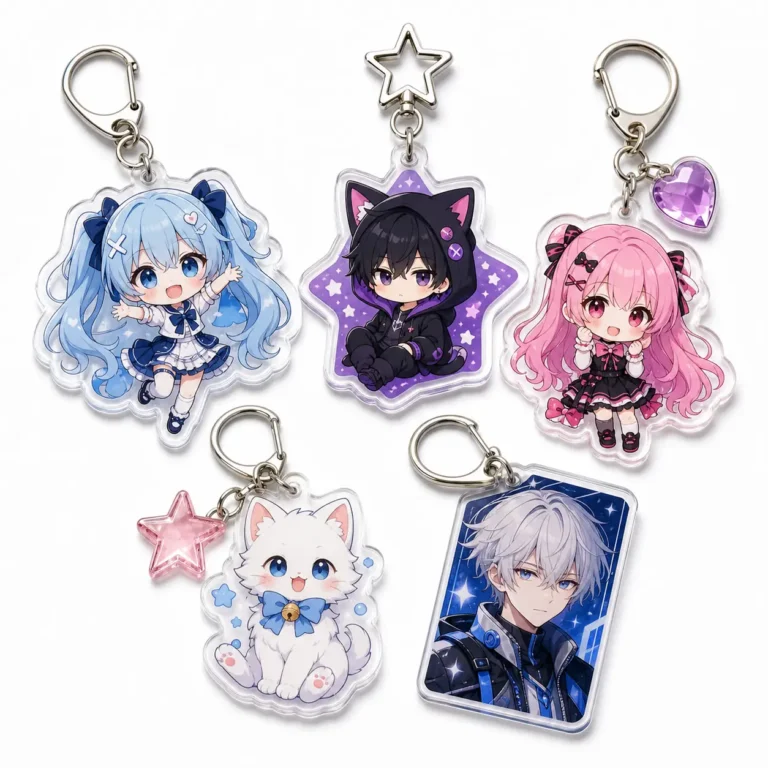
Custom acrylic keychains are lightweight, shatter-resistant, and take vibrant full-color printed designs; they’re typically made at about 3.0mm thickness to help prevent cracking.
They’re popular with retail shops, university stores, and artists because the clear plastic displays brand artwork beautifully while protecting the design from scratching and fading.
6 cm is the most common acrylic keychain size because it keeps the design visible without becoming awkward to carry.
The lighter weight lets you save money on shipping for bulk orders, and small 5–6 cm sizes are lightweight and cost-effective when ordering thousands of units. Medium 6–7 cm sizes help artwork details stand out, while larger 7–8 cm pieces are usually reserved for premium designs with more detailed artwork and a distinct style.
Acrylic pairs well with small-to-medium sizes and lobster clasps for rapid stock turnover, delivering great quality that retail customers appreciate in reviews.
The hardware connecting the ring to a keychain, bag, or pocket is as critical as the ring itself. Different attachment styles serve different carrying patterns and user behaviors.
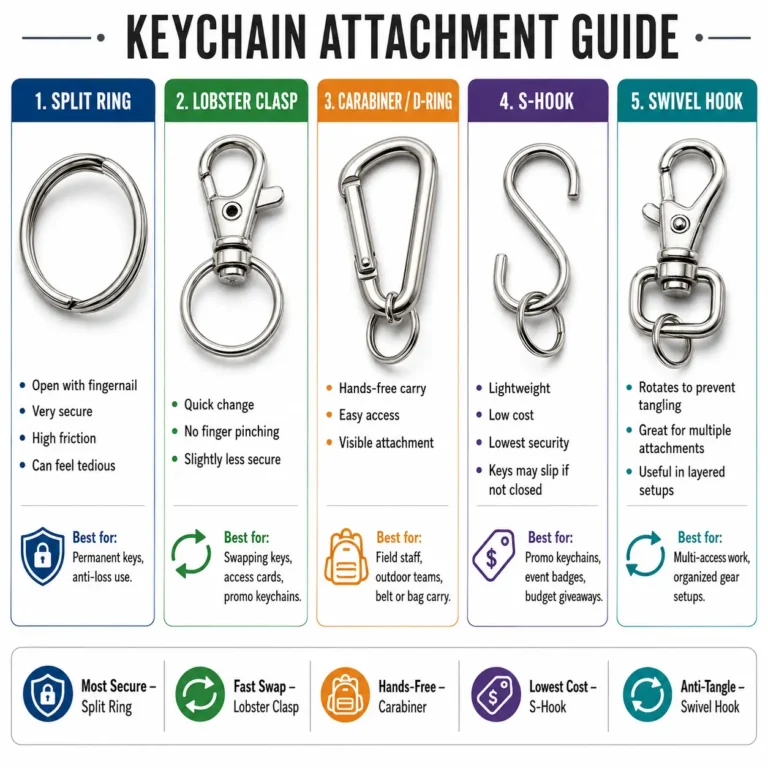
Split Ring: Simple overlapping ring requiring a fingernail to open. Absolute security and pinch-resistance but friction-heavy; users get tired of fighting it. Best for: institutional settings where keys never change or first-time keychains where protection against loss is priority.
Lobster Clasp: Spring-loaded latch for quick swaps without pinching. Slightly less secure but widely preferred in retail and work settings. Best for: frequent key swaps, badge access, promotional keychains.
Carabiner/D-Ring: Clip attachment to bag or belt for hands-free access. Best for: field workers, outdoor teams, visible-access scenarios.
S-Hook: Lightweight, affordable clip for bags or lanyards. Lowest security — keys slide off if not fully engaged. Best for: promotional keychains, festival badges, cheap-volume giveaways.
Swivel Hook: Rotating attachment preventing tangling. Essential when multiple items attach to one keychain. Best for: multi-access work environments, professionals with layered gear.
Chain Attachment: A 2–4 inch chain extending from the ring, useful for organizing key groups or extending reach without adding ring diameter. Best for: property management, industrial settings with multiple key clusters.
The power of this guide is combining size, material, and attachment into buyer-ready recommendations that your quality focus needs.
The table below shows how different institutional scenarios and each occasion map to configurations based on actual use. Which combination verifies the best fit for your application?
The following table synthesizes the above into ready-to-reference recommendations:
Use Case | Best Size | Ring Material | Attachment Type | Why |
|---|---|---|---|---|
Corporate/HR giftware | Medium (25–32mm) | Stainless or brass | Split ring | Broad appeal, secure, durable |
Car keys/valuable fobs | Large (32mm+) | Stainless steel | Swivel hook | Prevents scratching, organized |
Work badges/access | Small (19–25mm) | Stainless steel | Lobster clasp | Fast swaps, minimal weight |
Outdoor/sports teams | Medium–Large | Aluminum OK | Carabiner | External clip, accessible |
Retail/promotional stock | Small–Medium | Aluminum or acrylic | Lobster clasp | Cost-effective price, fast-moving |
PeaKeen is a professional business supplier for bulk custom keychains. Their team reviews your use case and recommends the size, material, and attachment combination most likely to keep recipients using the piece, whether for workplace security pins or promotional keychains. They can also support a custom order for a specific product application or project.
Every order includes a free digital proof confirming artwork, displayed shape, ring diameter, material thickness, and attachment placement.
On the website, customers can upload artwork and add customization details before approval of the proof.
That proof helps protect fine design details and confirms the cut shape. They also provide detailed pricing so you can budget accurately.
Email their sales team with your use case, key quantity, and order volume. Whether this is the first time you’re placing a bulk keychain order or you’re managing an ongoing procurement program, they’ll provide a custom quote with material recommendations tailored to your application, covering every detail from artwork refinement to final shipment by post or freight.
The team can help select the right option for the occasion and production timeline, with excellent support to make the process smooth and the result perfect. Check the website.

Table of Contents Packaging is often the last thing corporate buyers consider when designing a custom keychain. However, it completely

Table of Contents Fabric keychains are a popular choice for soft, lightweight custom merchandise. Woven and embroidered are the two
No. 5, Tongan Road,
East District Xiaolan Town,
Zhongshan, Guangdong,
China